

Why oral health professionals matter in the fight against HPV-related cancer
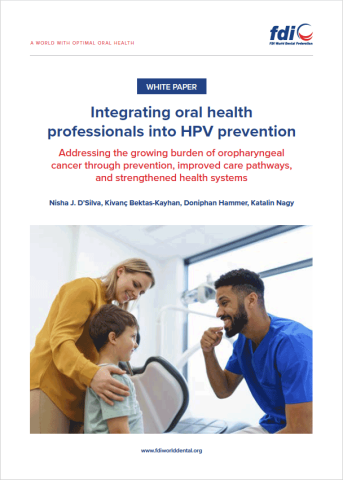
FDI’s new white paper highlights the vital role of oral health professionals in HPV prevention, vaccination and early cancer referral.

Human papillomavirus (HPV) is a major cause of cancer worldwide. In the USA, the UK and several European countries, HPV-positive oropharyngeal squamous cell carcinoma (OPSCC) has overtaken cervical cancer as the leading HPV-associated cancer. Yet oral health services remain largely absent from national HPV prevention strategies.
The new FDI white paper, “Integrating oral health professionals into HPV prevention”, examines the growing burden of HPV-associated OPSCC and sets out practical recommendations for oral health professionals, policymakers and health systems.
“Oral health professionals are uniquely positioned to play a key role HPV prevention,”
[Quote from the white paper].
Through regular contact with patients, the dental team can help provide trusted information, address misinformation, support vaccination efforts and identify suspicious findings that may require further assessment.
A missed opportunity in HPV prevention
The white paper draws on findings from the FDI Vision 2030 mid-term survey, which found that while 80.3% of responding countries have an HPV prevention policy, only 12.9% reported that oral health services were integrated into their HPV prevention programmes.
This represents a significant missed opportunity. Dentists and the wider oral health professional team have regular contact with children, adolescents, young adults and families, including many of the people who may benefit from HPV vaccination.
Evidence also shows that healthcare provider recommendations are a key driver of HPV vaccine uptake. However, a lack of confidence, uncertainty about scope of practice and discomfort discussing HPV-related topics continue to limit the involvement of oral health professionals.
At the same time, patients and parents appear broadly receptive to receiving HPV-related information from oral health professionals.
Tackling stigma with clear, patient-centred communication
The white paper emphasizes that effective communication is central to HPV prevention.
Because HPV is often associated with sexual transmission, conversations can be affected by stigma, misinformation and misconceptions about vaccination.
“Normalizing conversations about HPV can help reduce stigma and support informed decision-making about vaccination and follow-up,” the paper states.
Targeted education and practical communication tools can help build the confidence of oral health professionals and support consistent, evidence-based messaging across the health system.
Supporting early recognition and referral
Unlike some oral cancers, a clearly identifiable precancerous lesion for HPV-associated OPSCC has not yet been established. Prevention therefore remains particularly important.
Routine oral examinations nevertheless provide an opportunity to recognize suspicious signs and symptoms and facilitate timely referral.
The white paper stresses that HPV-associated findings should be managed through existing referral pathways for suspected oral or oropharyngeal malignancy. It does not propose a separate HPV-specific diagnostic pathway.
Integrating oral health into national HPV strategies
FDI is calling for greater collaboration between oral health services, vaccination programmes, primary care, public health and cancer control programmes.
Key priorities include:
- including oral health professionals in national HPV prevention strategies;
- strengthening HPV education in dental and allied oral health professional training;
- clarifying professional roles and responsibilities;
- establishing clear referral pathways for vaccination and specialist assessment; and
- ensuring prevention strategies are equitable, culturally sensitive and adapted to local health systems.
The publication provides an evidence-based guidance and practical tools to support oral health professionals in HPV prevention, communication and the recognition of suspicious findings. It is intended to complement, not replace, existing clinical guidance.
As the global burden of HPV-associated OPSCC continues to grow, FDI is calling for oral health to be recognized as an essential part of the wider response to HPV-associated cancer.